Share the page
World Mangroves Day: For more than 10 years, the FFEM has been working to restore essential ecosystems to tomorrow’s coasts
Published on

On the occasion of the International Day for the Conservation of the Mangrove Ecosystem, celebrated on July 26, FFEM highlights more than ten years of commitment to the restoration of these essential coastal ecosystems. From Africa to Asia, via the Caribbean and the Indian Ocean, the projects supported demonstrate that it is possible to reconcile biodiversity protection, adaptation to climate change and improvement of living conditions for local communities.
Mangroves, essential ecosystems under severe pressure
On the border between land and sea, mangroves are among the planet’s richest and most productive ecosystems. They protect coastlines from erosion and storms, store large amounts of carbon, harbour exceptional biodiversity, and play an essential role for coastal populations that depend on them for food, economic activities, and security. Yet these ecosystems are now under severe threat from the effects of climate change and human-induced pressures.
«Having shrunk by about 25% since the 1970’s, mangrove areas are now threatened by land artificialization, their conversion for aquaculture and livestock farming, pollution, as well as their exploitation for firewood or other uses».

Present in 124 countries, mangroves cover less than 1% of tropical forests and only 0.4% of the global forest area. Yet they provide indispensable ecosystem services.
Some key figures :
- Mangroves store significant amounts of carbon, accounting for nearly 9% of global blue carbon stocks;
- A 500-meter mangrove strip can reduce wave height by 50-99% ;
- They contribute to food security, livelihoods and the protection of millions of people living in coastal areas.
Sources: United Nations
Faced with these challenges, restoring mangroves is a major lever to combat climate change, preserve biodiversity and strengthen the resilience of coastal territories.

Capitalizing on experiences to restore mangroves more effectively
For nearly 10 years, the FFEM has supported projects that demonstrate that it is possible to reconcile mangrove restoration, biodiversity preservation and local development.
These actions are part of the Resilience of Aquatic Ecosystems strategy and contribute to the objectives of the United Nations Decade for Ecosystem Restoration (2021-2030).
Beyond funding projects, the FFEM has made capitalizing on experience a key focus of its action.
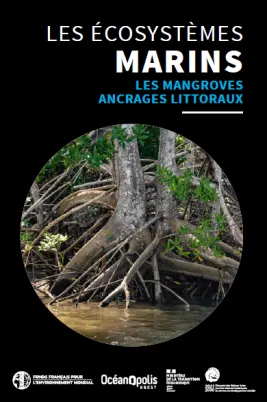
Launched in 2019, the "Mangroves Initiative" aims to build, from proven field experiences, a common knowledge base on the conditions for successful mangrove restoration. It currently brings together 4 projects supported by the FFEM, deployed in different regions of the world: in Asia, West Africa, Central America and the Indian Ocean.
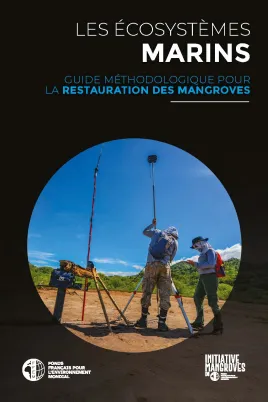
These exchanges of experiences have made it possible to enrich scientific and technical knowledge and have led, In 2024, the publication of a methodological guide on mangrove restoration aimed at supporting project leaders and practitioners is leading to more effective restorations.
Concrete results for mangroves and coastal communities
The experience acquired by the FFEM is reflected in concrete achievements on the ground.
The Costa-Rica - Benin project has made significant progress in:
- Restoring 13 hectares of mangroves in Costa Rica and 9 hectares in Benin;
- Train many local stakeholders;
- Raise awareness among school audiences about mangrove conservation
- Develop income-generating activities (ecotourism, beekeeping, food truck, etc.);
- Strengthen national skills in mangrove conservation.
"Thanks to the canals we built, we have restored the natural flow and reflux of water, essential for the proper functioning of the mangrove. We then proceeded to reforestation, which was successful and restored the mangrove to its original state.”

This dynamic continues today through several projects supported by the FFEM.
In the Caribbean, the REMAR Mangroves OECS project is helping to restore mangrove ecosystems. In Madagascar, the GECP BATAN project supports the sustainable management of coastal ecosystems. In West Africa, the RETCAO project, which builds on the achievements of the WACA project previously supported by the FFEM, is developing, together with local communities, nature-based solutions to strengthen coastal resilience to the effects of climate change.
The latest example is the PAPEC project, inaugurated on 17 June in the presence of the French ambassador to Madagascar, which aims to preserve mangroves in the Boeny region by involving local stakeholders in their sustainable management.

Train and share knowledge to change scale
Because the restoration of mangroves is also based on knowledge sharing, the FFEM continues its commitment to the dissemination of knowledge.
Through the project Train to conserve, it supports the development of training programs on several environmental themes, including mangroves (tutorial at the end of the article).
By supporting innovative projects, capitalizing on feedback and disseminating the knowledge acquired, the FFEM confirms its commitment to mangrove restoration. An action that contributes to preserving ecosystems essential for the climate, biodiversity and coastal populations.