Share the page

Fostering the development of an innovative sustainable electricity network in rural areas (Nanoé)
Project
This project is carried out with the support of the European Union.


-
Project start date
-
Status
In progress
-
Estimated date of project termination
-
-
Project financing date
-
-
Financing duration
-
4 years
-
Type of program
-
FFEM
-
Global financing amount
-
€ 9 100 000
-
FFEM financing amount
-
€ 2 400 000
-
Project lead member institution(s)
-
Agence française de développement (AFD), French Ministry of the Ecological Transition
-
Country and region
-
Madagascar
-
Type of financing
-
Beneficiaries
-
Nanoé

This project is carried out with the support of the European Union.
The content of this project sheet is the sole responsibility of the FFEM and does not necessarily reflect the opinions of the European Union.
In Madagascar, due to the lack of an efficient energy service, a majority of the inhabitants do not have access to electricity. To address the economic, social and environmental consequences, the Nanoé project supported by the FFEM aims to deploy an innovative model of nano-networks in rural areas.
Context
While the population is set to double by 2050, over 20 million Malagasy in a total population of 28 million currently live with no electricity. Most depend entirely on “traditional” methods for lighting: wood fires, candles, petrol lanterns, torches. Furthermore, people aged under 35 - making up over two-thirds of the population - are for the most part without stable employment so are economically insecure. In this context, access to low-cost renewable electricity is an economic, social and environmental necessity.
Supported by the FFEM, the project from the French-Malagasy company Nanoé is working to facilitate the development of an innovative lateral electrification model, something made possible by renewable energies as well as new information and communication technologies.
Description
The project has 4 components:
- Consolidate the lateral electrification model in preparation for its upscaling on a technological, organisational and institutional level.
- Progressive roll-out of new lateral electrification platforms, structuring entrepreneurial industries, constructing nano-networks (intelligent solar arrays) and connecting subscribers.
- Undertake set of small-scale technological and social experiments alongside phased roll-out of the model to allow it to ultimately magnify its economic and social impact.
- Analyse and share the programme’s results and preparing its subsequent phases.
Outcomes
• Deploy an additional 6,000 nanoarrays in 8 rural districts of the 4 northern regions of Madagascar.
• Open 6 new lateral electrification platforms at the service of nano-entrepreneurs from 8 districts.
• Train and support 270 young rural nano-entrepreneurs.
• Connect 40,000 subscribers, including more than 2,000 merchants, and 1,000 public lighting points to an affordable and sustainable basic electrical service.
• Implement operational microfinance solutions for nano-entrepreneurs.
Innovative and exemplary features
The program, supported by FFEM and other French partners, is a source of many innovations. Indeed, the smart grids project – which combines digital and electricity technologies – offers a new progressive and flexible approach, by creating nano-networks in isolated villages, thanks to the interconnection of individual solar kits. Moreover, the innovations implemented aim to organize a horizontal industry of rural services around a community of independent entrepreneurs, trained within the framework of the project. The commissioning of these nano-networks constitutes the basic service, with possible scalability to other services for entrepreneurs. In financial terms, the project aims to open up a new field of action for microfinance in the sector of construction of decentralized mini-infrastructures closer to the needs of the field.
Sustainable Development Goals
ODD7 Affordable and clean energy
ODD8 Decent work and economic growth
ODD13 Climate action
Our innovative projects to provide access to electricity
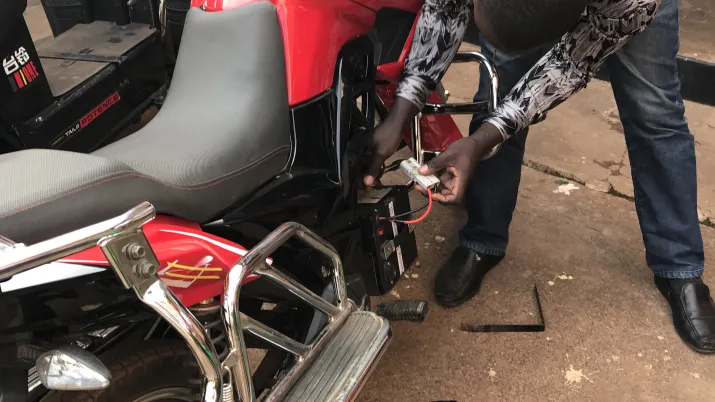
ZEMBO : Solar-powered motorcycle taxis to help promote energy transition in Ouganda
Completed
2019 - 2021