Share the page

Promoting sustainable opportunities in the excellent cocoa value chain (KAOKA)
Project

-
Project start date
-
Status
Completed
-
Estimated date of project termination
-
-
Project financing date
-
-
Financing duration
-
5 years
-
Type of program
-
FFEM
-
Global financing amount
-
€ 8 900 000
-
FFEM financing amount
-
€ 2 650 000
-
Project lead member institution(s)
-
French Ministry of the Ecological Transition
-
Country and region
-
Ecuador, Peru, Colombia
-
Type of financing
-
Partners
-
Alliance Bioversity-CIAT, Biocacao, Fundación Kaoka, ICRAF, kakao
-
Beneficiaries
-
Alliance Bioversity-CIAT

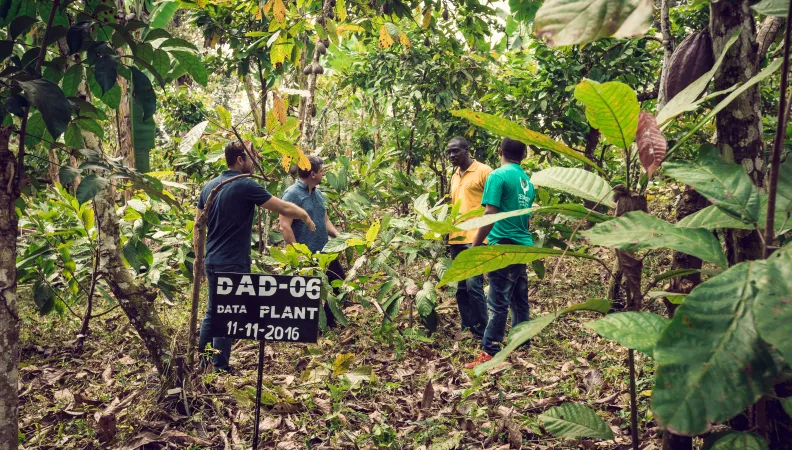
With a view to improving the excellent cocoa value chain in the Amazon region, Alliance Bioversity-CIAT, Kaoka and Conservation International are working to implement sustainable production to boost income for producers and to protect the forest. The FFEM supports the consortium’s collaboration, which brings together private-sector business, NGOs and a research body, to promote an innovative and integrated approach to the region.
Context
Colombia, Ecuador and Peru account for 10% of global cocoa production, with expertise being passed down through generations of the region’s indigenous populations. It also provides a significant source of income, particularly for rural populations, owing largely to the increase in production brought about by high demand from international markets over recent years. However, the expansion of agricultural land particularly threatens forest ecosystems in the three countries.
In light of this, the project sponsors aim to encourage sustainable cocoa cultivation in agroforestry through a profitable economic model integrated into a functional value chain, so avoiding further deforestation. The FFEM is working alongside these stakeholders as they look to combine ecosystem preservation with local development.
Description
The project has four components:
- Develop an integrated operating vision, using cocoa agroforestry systems to address production-related issues such as soil restoration and landscape conservation.
- Bolste infrastructure and the capabilities of producers and their organisations throughout the cocoa value chain, from production to final sale.
- Create and deploye instruments for impact analysis and monitoring productive landscapes in the project’s area of influence, with the involvement of communities
- Capitalise the experiences and lessons learned in terms of sustainable agricultural practices and the conservation of biodiversity and forest ecosystems.
Outcomes
• Training in post-harvest processes for employees of three producer organizations, and strengthening post-harvest processing infrastructure
• Certify organic or fair 460 ha of new plantations in agroforestry and 410 ha of cocoa trees renovated in agroforestry 45 additional tonnes of dry beans sold over the duration of the project
• Increase producers' income and clear definition by the organizations of the market to which they are entitled.
• Improve the physico-chemical health of soils.
• Develop adapted, systematized and shared methodologies for soil recovery.
• Monitor by organizations the land use and deforestation.
• Produce technical-scientific and/or communication materials.
Innovative and exemplary features
Supported by the FFEM, this project provides an innovative demonstration of the value and effectiveness of integrated solutions at regional level, combining the sustainable value chain with ecosystem conservation to protect forests and soils.
In addition, by relying on the sharing of expertise and skills at regional level through a public-private partnership, this initiative is exemplary: helping to disseminate and harness undervalued existing expertise, and capitalise on relevant experiences.
A further particularly innovative development at this scale is the management by local organisations of their own system for controlling and monitoring deforestation, using geographic information systems (GIS) and public tools.
Kaoka project on RFI
Sustainable Development Goals
ODD8 Decent work and economic growth
ODD12 Responsible consumption and production