Share the page
The FFEM Mangroves Initiative: Building our resilience on nature
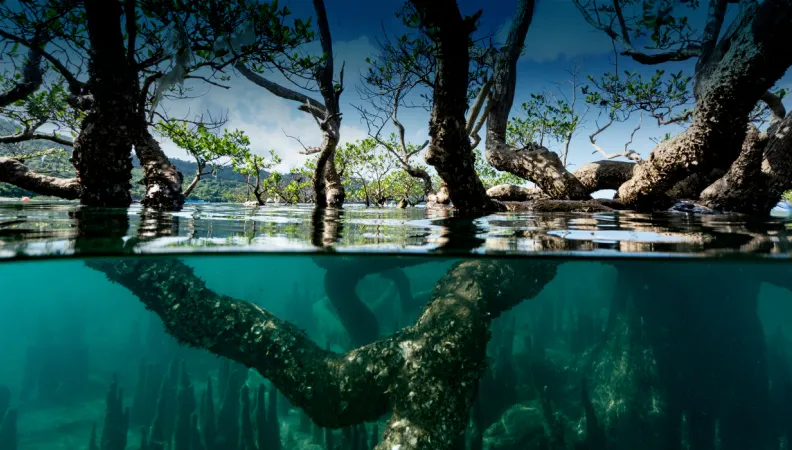
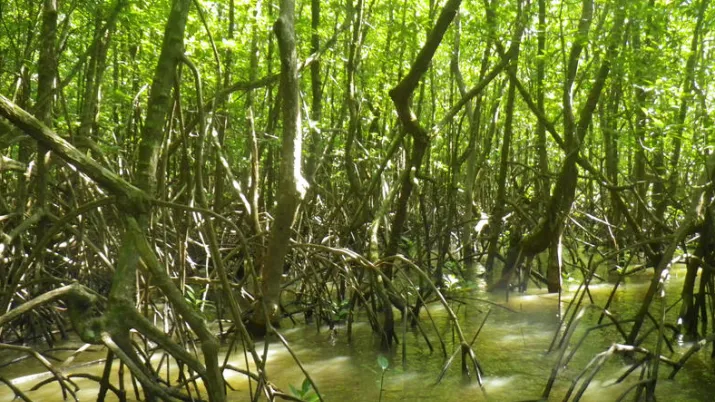
The mangrove plays a major role in mitigating and regulating the impacts of climate change: it is both a bulwark against the violence of storms and contributes to carbon sequestration and storage. It is also essential for the maintenance of nearby local populations, particularly as a habitat and nursery for species exploited for local economic development.
The Mangroves Initiative
Mangroves Initiative
The French Global Environment Facility (FFEM) has been supporting projects to strengthen coastal resilience and adapt to climate change for several years.
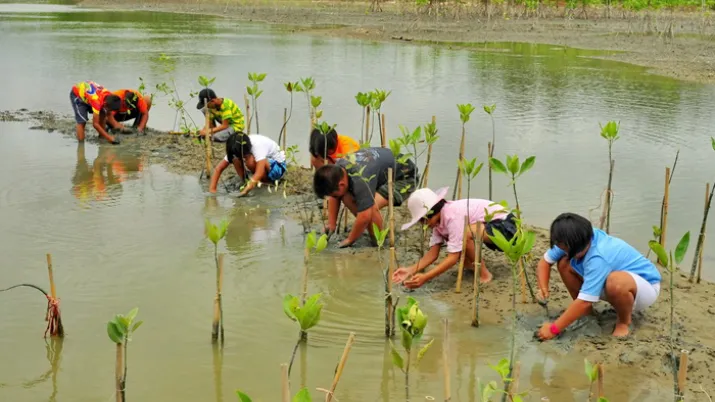
The Mangroves Initiative envisages the role of mangroves as a nature-based solution: through the restoration of ecological functionalities of mangroves, the restoration of environmental conditions and uses favorable to their natural regeneration, ecological engineering, or the "gray and green" solutions, which combine infrastructure and soft solutions.
The latter is based in particular on research work developed as part of a thesis, co-sponsored by the Center for Functional and Evolutionary Ecology of Montpellier and the CREOCEAN design office.
Through the Mangroves Initiative, the FFEM wishes to develop exchanges of experience between projects for the protection and regeneration of mangrove coastlines, to feed scientific and technological knowledge, to capitalize on and enhance their achievements.
The objectives
The challenge of this initiative is to collectively build, based on proven experiences, a solid case for the importance and methods of restoring mangroves. This initiative is part of the United Nations Decade on Ecosystem Restoration (2021-2030).
1. Nurturing scientific and technological knowledge ...
... Through scientific monitoring in the field of mangrove restoration and green belts, on the maintenance of their functionality, their capacity to mitigate climate change impacts and their role in carbon sequestration and storage. It is also a question of training on initiatives other than those of the FFEM in this field.
This monitoring consists of a follow-up of the numerous mangrove restoration projects in the world, practical guides and new technologies developed. These pieces of information will be fed by the experts and their network, as well as by a monitoring work. They will be made available to all, online on the website of the initiative.
2. Develop exchanges of experiences ...
... By networking projects; evaluating the different technologies deployed, their effectiveness, advantages and disadvantages, and cost; assessing their appropriation by local communities and the benefits provided.
Seminars are organized each year on a different site. The aim is to discuss the experiences, methods and results of the visited project, but also to analyze the successes or failures recorded by the projects, with a view to cross-functional capitalization. A final restitution seminar is organized in France with all the actors working on these subjects.
3. Capitalize and enhance the results ...
... Through the production of capitalization documents and valuation tools.
The experiences are regularly documented during seminars and field visits in order to feed the capitalization and communication tools. A final capitalization document is produced in the form of a methodological guide.
The promotion of the initiative is achieved through:
practical sheets on the tools and methods developed,
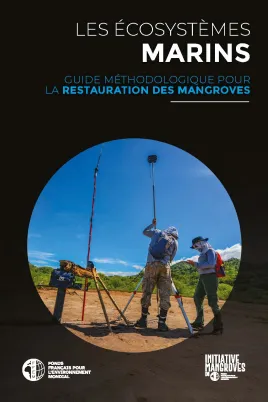
2 methodological capitalization guides on mangrove restoration,
a tutorial dedicated to mangroves that has already trained 1500 students after only 2 months,
an illustrated book for the general public on the role of mangroves and the experiences of projects,
the production and distribution of films and photos of projects,
the publication of the proceedings of the final seminar,
exhibitions,
the FFEM website: www.ffem.fr
The latest news from the Mangroves Initiative
Below you will find the latest publications of the Mangroves Initiative
Download the latest mangrove restoration guide
News of the Mangroves Initiative
Mexico (Campeche): 21st International Congress on Environmental Sciences and Mangrove Restoration
Published on September 4, 2024
Methodological Guide for Mangrove Restoration – FFEM – 2024
Published on April 23, 2024
Events on mangroves
Published on February 25, 2023