Share the page
When energy innovation brings lasting change to regions
Published on
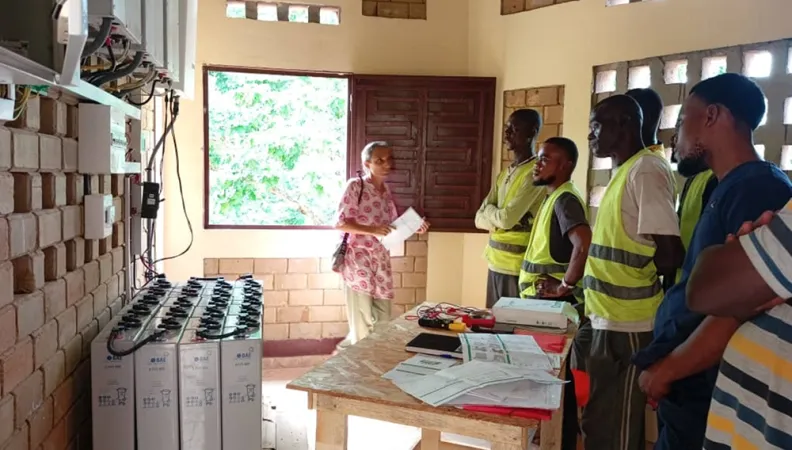
In the context of climate change, it is essential to highlight the central role of engineering in mitigating its effects. On World Engineering Day for Sustainable Development, the Pot@maï project provides a concrete example of this ambition.
Led by the Ministry for Ecological Transition and supported by the FFEM in partnership with the EU, the AFD as part of the Program for Energy Efficiency in Buildings (PEEB), the AURA Region, the Hauts de France Region, the Rothschild Foundation, and the Air France Foundation, the project deploys an innovative solution combining tidal and solar energy to power essential services in rural areas.
As part of the PEEB initiative, which aims to combat energy poverty while bringing about lasting change in the sector's practices, Pot@maï demonstrates that simple engineering, developed in collaboration with local communities, can become a lever for energy and economic independence.
From prototype to replicable model: Pot@maï scales up
In sub-Saharan Africa, the electrification rate stands at 31%, falling to 12% in rural areas. On the Congo River, a source of both life and energy, an alternative has gradually taken shape.
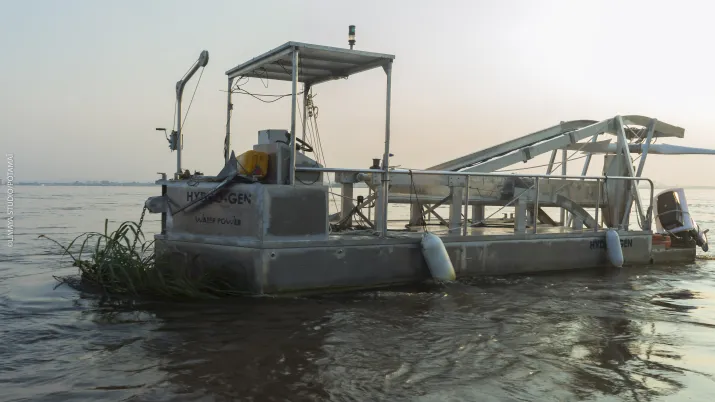
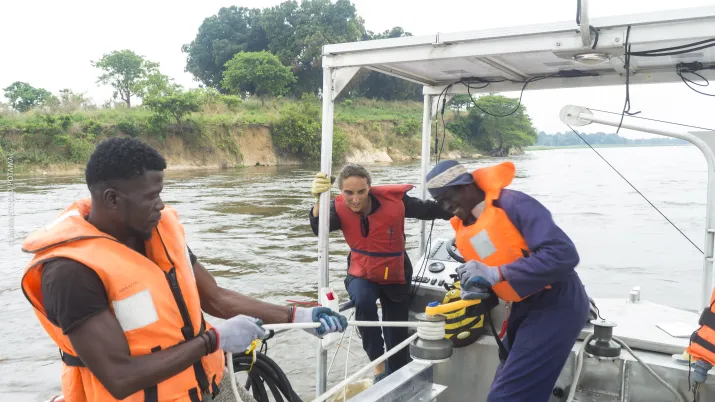
The first phase of the project saw the commissioning of the first hydroelectric barge manufactured in Congo and operated by an entirely Congolese team—a major step forward in local control of energy production. An in-depth preliminary feasibility study enabled the selection of the most suitable hydroelectric model and the sizing of equipment according to the needs of the population. The project also supported the recruitment and training of managers, as well as the creation and monitoring of the micro-management company.
Supported by the FFEM's Innovation Facility for the Private Sector (FISP), the Hydro-Gen technology developed by L'Aquaphile is specifically designed for isolated sites and poorly equipped contexts.
The second phase builds on these achievements to deploy new Essential Service Units (ESUs) combining tidal and solar power. Designed in collaboration with local communities, they guarantee access to drinking water, refrigeration, agricultural processing, and the development of local economic activities, while accelerating the low-carbon transition.
The results are tangible: a secure cold chain, drinking water production guaranteed for the next 20 years, and local production of cassava flour and peanut paste. The involvement of women and the training of local populations remain at the heart of the model.
How the project changed the lives of the inhabitants of Mbamou
The PEEB, strategic support for scaling up
The transition from experimentation to a structured model is fully in line with the Program for Energy Efficiency in Buildings (PEEB).
By combining operational implementation and institutional structuring, the PEEB enables local innovation to be transformed into a sustainable sectoral dynamic.
It thus supports the deployment of USEs while helping to strengthen the resilience of buildings in the face of extreme weather events, economic crises, and energy shortages.
Engineering designed with and for the regions
The project is based on two complementary technological pillars, resulting from a joint innovation effort between Congolese and French stakeholders.
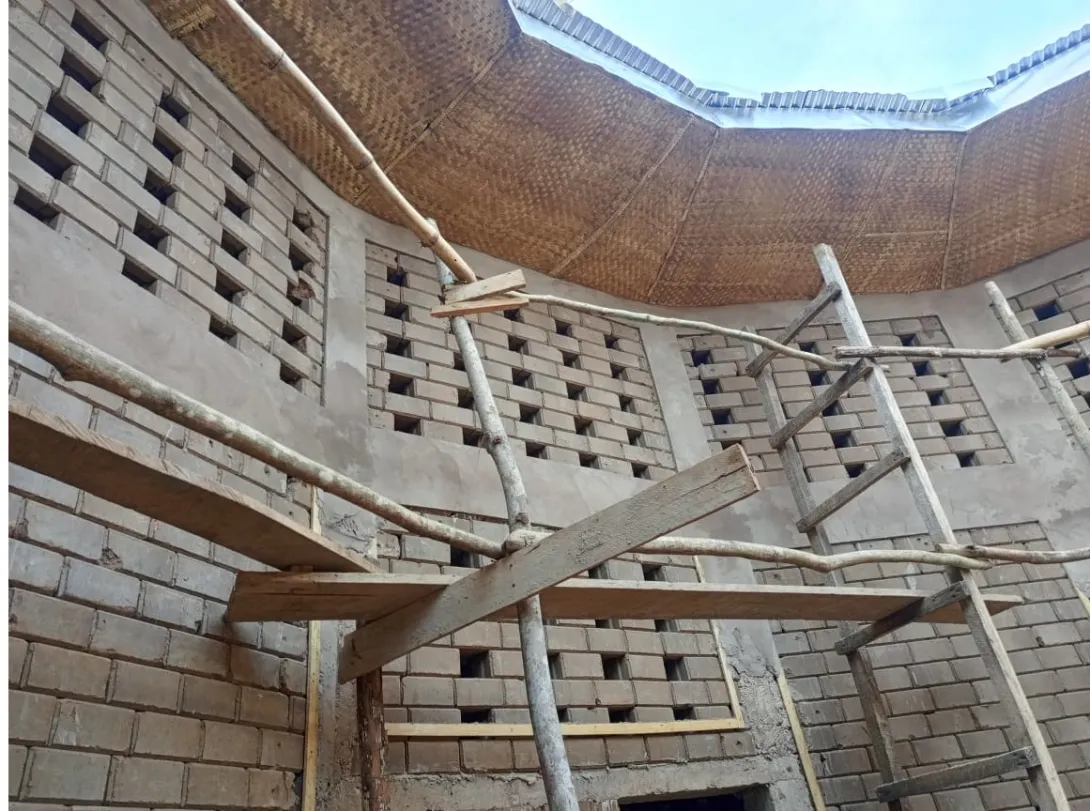
First pillar: bioclimatic engineering.
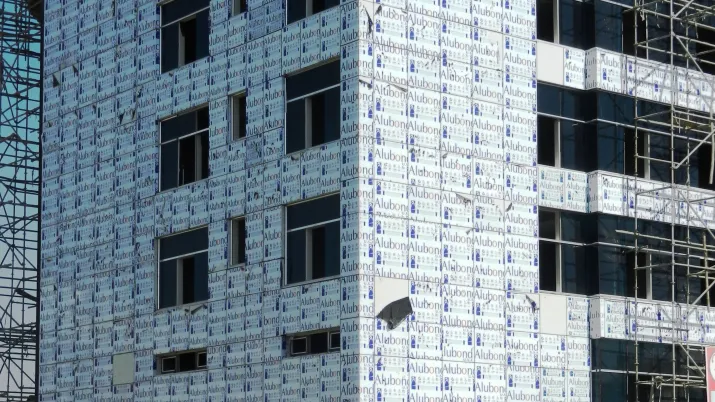
The buildings housing the USEs, designed by a Congolese architect and optimized using dynamic thermal simulations carried out by a French engineering firm with the support of the PEEB, are adapted to local climatic constraints (heat, humidity, natural ventilation). This approach significantly reduces energy requirements and operating costs.
Second pillar: tidal turbine engineering.
The barges developed by a French start-up have been tested and improved in Congo. The challenge now is to optimize their performance in real conditions and transfer the skills needed for local manufacturing of complex parts and component maintenance.
Beyond electricity: a sustainable economic model based on shared expertise and co-construction
Essential Service Units do more than just generate electricity. They generate revenue by transforming and selling products that directly meet the needs of communities.
This integrated model promotes the emergence of a local technical ecosystem capable of designing, producing, and maintaining energy solutions adapted to local realities. It combines skills transfer, the involvement of women in technical and decision-making positions, and the active participation of local populations in defining priority services.
Each ESS ensures continuous access to essential services, creates sustainable jobs in rural areas, and preserves the environment thanks to a solution that does not require heavy infrastructure.
Simple, inclusive, and replicable engineering
By combining international expertise, Congolese know-how, and skills transfer, Pot@maï contributes to the achievement of several Sustainable Development Goals.
More than just a technological solution, the project embodies a partnership approach that promotes autonomy, resilience, and development driven by the regions themselves. Ultimately, this dynamic paves the way for the dissemination of innovative, sustainable, and replicable energy models on a larger scale.